


Unauthorized drones are becoming one of today’s fastest-growing security threats
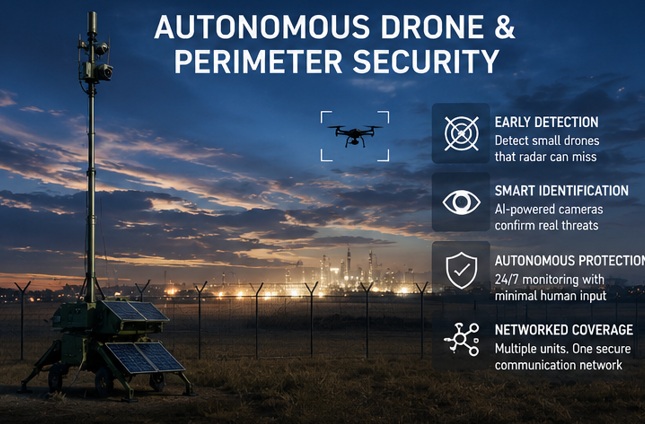
Manufacturer's system – autonomous drone and perimeter security system
The system offered by the company is an advanced autonomous perimeter protection and drone early detection system designed for monitoring critical infrastructure, military facilities and temporary protection zones. The system focuses on detecting, tracking and identifying small commercial drones using a combination of artificial intelligence, optical, thermal and acoustic sensors.

A problem in the market
- Small commercial drones are becoming one of the fastest-growing security threats.
- Traditional radar systems are often ineffective against low-flying small drones.
- Nighttime detection and monitoring remain challenging.
- Many facilities do not have a cost-effective early warning system.
- The biggest risk targets are military facilities, airports, energy infrastructure, ports and government buildings.
Solution – Manufacturer System Platform
- · The system is designed for autonomous long-term work in challenging environments.
- · The Edge-AI architecture used allows data analysis to be executed on-premises.
- · The platform is equipped with 4K optical cameras, a thermal imager and a matrix of directional microphones.
- · The built-in PTZ (Pan-Tilt-Zoom) camera allows you to automatically direct the surveillance to the detected object.
- · The telescopic mast and stabilization system ensure quick deployment.

Autonomous operation
- · Solar panels ensure continuous charging of the batteries.
- · The system can operate for long periods of time without an external power source.
- · Suitable for working in remote or challenging areas.
- · Intelligent power management allows you to switch to standby mode and activate quickly.
Networked Security Architecture
- · Several stations offered by the system offered by the Company can form a common security network.
- · The military-grade MESH connection used ensures secure data transmission.
- · AI algorithms perform local detection and classification on each node.
- · The system is optimized for low network load – only the most important metadata is transmitted.

Acoustic Detection Technology
- · The directional microphone system analyzes the differences in the arrival of sound waves.
- · AI identifies specific audio signatures of drone propellers and motors.
- · The system determines the direction of the drone and automatically directs optical sensors.
- · This allows you to operate effectively in conditions of poor visibility or visual noise.

AI Detection and Identification Pipeline
- · The wide-angle camera performs the initial detection of the object.
- · The optical zoom camera performs detailed identification.
- · AI classification models determine the type of object and the level of threat.
- · The system is able to distinguish drones from birds or other errant objects.

Perimeter protection and geofences
- · The system creates virtual geofences around protected objects.
- · Thermal imagers monitor the movement of people and vehicles.
- · AI automatically identifies intrusions and activates PTZ cameras and spotlights.


Value proposition
- · Lower cost per security object compared to radar-based systems.
- · Fast deployment and mobility.
- · A resilient architecture that can work even in the event of a connection failure.
- · Constant updating of AI models without changing hardware.

Target market
- · Armed forces and air defense units.
- · State Security Agencies.
- · Critical infrastructure operators.
- · Defence systems integrators and technology partners.
Conclusion
- · The system offered by the company offers a modern, mobile and cost-effective response to the growing threat of small drones.
- · The system combines AI, optics, thermal vision, and acoustic detection into one autonomous security platform.
- · Due to its modular architecture and networked operation principle, the solution is suitable for both military and civilian objects.